
In today’s competitive digital world, simply running ads or posting on social media is not enough. Businesses need a structured system that turns strangers into loyal customers. That system is called a marketing funnel.
At DigitalNest Agency, we help brands design strategic funnels that generate leads, nurture prospects, and drive consistent conversions. If you want to compete with freelancers and digital marketers in the market, understanding the marketing funnel is your first step toward building a powerful digital presence.
In this detailed guide, we will explain:
What a marketing funnel is
The key stages from awareness to conversion
How to build a high-converting funnel
Tools and strategies for each stage
Common mistakes to avoid
Let’s get started.
What is a Marketing Funnel?
A marketing funnel is a step-by-step journey that a potential customer goes through before making a purchase.
It is called a funnel because:
At the top, many people discover your brand.
In the middle, fewer people show interest.
At the bottom, a smaller group converts into paying customers.
The goal of a marketing funnel is simple:
👉 Turn attention into trust, and trust into sales.
The 3 Main Stages of a Marketing Funnel
1. Awareness Stage (Top of Funnel – TOFU)
This is where people discover your brand for the first time.
They may not know:
Who you are
What you offer
Why they need you
Your goal here is visibility and attention, not selling.
Awareness Strategies:
SEO-optimized blog posts
Social media content
Instagram Reels & YouTube Shorts
Google Ads
Facebook & Instagram Ads
Influencer marketing
Educational content
Example:
If someone searches:
“What is digital marketing?”
And they land on your blog, that is the awareness stage.
At DigitalNest Agency, we focus on creating high-value educational content that builds brand recognition and trust from the first interaction.
2. Consideration Stage (Middle of Funnel – MOFU)
Now the audience knows about you.
They are:
Comparing options
Researching solutions
Looking for trust signals
This stage is about building credibility and authority.
Consideration Strategies:
Case studies
Testimonials
Email marketing
Webinars
Free guides
Comparison blogs
Retargeting ads
Here, your job is to answer questions like:
Why should I choose you?
What makes you different?
Can I trust your results?
Since your website is still growing and competitors are freelancing individually, this is your opportunity to position DigitalNest Agency as a professional agency brand, not just another freelancer.
3. Conversion Stage (Bottom of Funnel – BOFU)
This is where people are ready to buy.
They need:
Clear pricing
Clear benefits
Simple call-to-action
Risk reduction (guarantees, testimonials)
Conversion Strategies:
Landing pages
Free consultation offers
Limited-time discounts
Strong CTAs
Live chat support
Demo calls
Example CTA:
“Book a Free Strategy Call Today”
At DigitalNest Agency, the focus should be:
Clear service pages
Strong portfolio
Transparent offers
Easy contact form
The easier you make the decision, the higher the conversion rate.
Bonus Stage: Retention & Loyalty (Post-Conversion)
Most people stop at conversion. Smart marketers go beyond.
After someone becomes a client:
Provide excellent service
Offer upsells
Ask for testimonials
Encourage referrals
This builds long-term growth and recurring revenue.
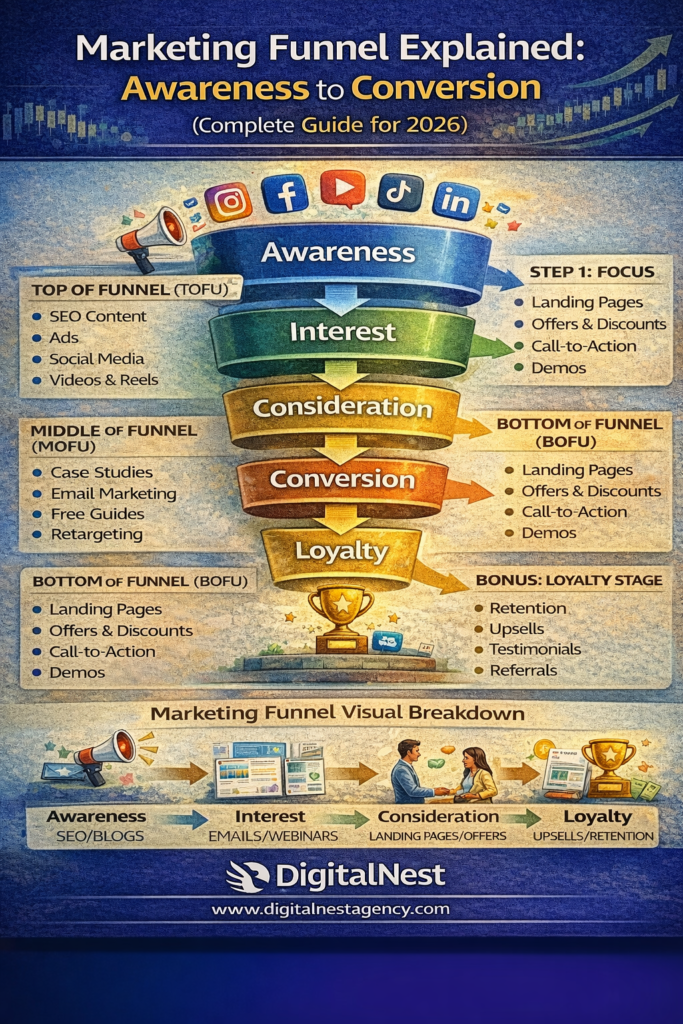
Marketing Funnel Visual Breakdown
Here’s how the funnel works:
Awareness → Interest → Consideration → Conversion → Loyalty
Each stage requires different content and strategies.
If you try to sell directly in the awareness stage, you lose trust.
If you educate properly, sales happen naturally.
How to Build a High-Converting Marketing Funnel
Step 1: Define Your Target Audience
Ask:
Who is your ideal customer?
What problems do they face?
What platforms do they use?
Without clarity, your funnel will fail.
Step 2: Create Content for Every Stage
Do not post random content.
Create:
SEO blogs (Awareness)
Case studies (Consideration)
Landing pages (Conversion)
Consistency builds authority.
Step 3: Use Lead Magnets
Offer something valuable:
Free eBook
Free checklist
Free consultation
Free audit
This helps you collect emails and nurture leads.
Step 4: Use Email Marketing Automation
Once someone downloads your free guide:
Send follow-up emails
Educate them
Build trust
Offer services
Email marketing increases conversion rates dramatically.
Step 5: Track & Optimize
Measure:
Website traffic
Click-through rate
Conversion rate
Cost per lead
Improve what works. Fix what doesn’t.
Marketing funnels are not “set and forget.” They require optimization.
Common Marketing Funnel Mistakes
Selling too early
No clear CTA
Weak landing pages
Ignoring email marketing
Not tracking performance
No retargeting strategy
Avoid these, and your funnel will perform much better than most freelancers in the market.
Why Your Business Needs a Marketing Funnel in 2026
Digital competition is increasing every year.
People don’t buy instantly.
They:
Research
Compare
Validate
Then decide
If you don’t guide them properly, your competitors will.
At DigitalNest Agency, we focus on building structured digital systems — not random marketing.
Final Thoughts
A marketing funnel is not just a theory.
It is the backbone of digital marketing success.
From awareness to conversion, every stage must be strategically designed.
If you want to compete with freelancers and stand out as a professional digital marketing agency, building a proper funnel is non-negotiable.