
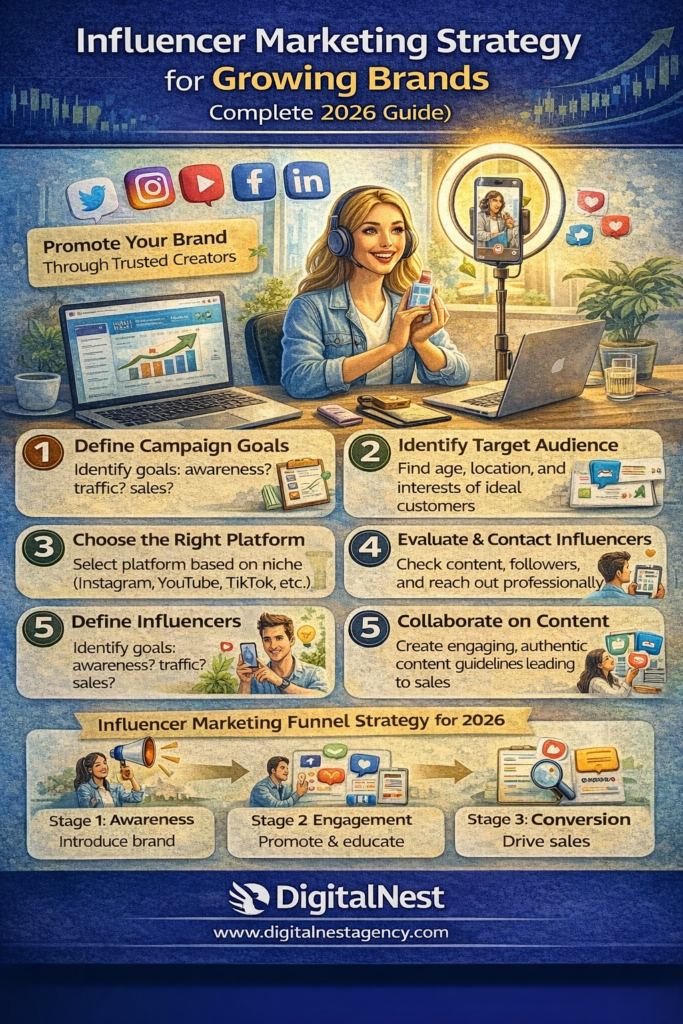
In 2026, consumers trust people more than advertisements. That’s why influencer marketing has become one of the most powerful digital marketing strategies for growing brands.
At DigitalNest Agency, we focus on performance-driven influencer campaigns that generate real engagement, leads, and sales — not just likes. While many competitors operate as freelancers, we build structured influencer marketing systems designed for long-term brand growth.
In this guide, you will learn:
What is influencer marketing?
Why it works in 2026
Types of influencers
Step-by-step influencer marketing strategy
How to measure ROI
Common mistakes to avoid
What is Influencer Marketing?
Influencer marketing is a strategy where brands collaborate with content creators who have an engaged audience on platforms like:
Instagram
YouTube
Facebook
LinkedIn
TikTok
Instead of directly advertising, brands promote products or services through trusted personalities.
This creates:
✔ Higher trust
✔ Better engagement
✔ Stronger brand credibility
✔ Increased conversions
Why Influencer Marketing Works in 2026
Consumers are overloaded with ads. Traditional marketing feels promotional.
Influencer marketing works because:
It feels authentic.
It connects emotionally.
It builds social proof.
It reaches targeted communities.
Modern audiences trust creators more than brand ads.
Types of Influencers
Choosing the right influencer is critical.
1. Nano Influencers (1K–10K followers)
High engagement rate
Affordable
Best for local or niche brands
2. Micro Influencers (10K–100K followers)
Strong niche authority
Balanced cost & reach
Ideal for growing brands
3. Macro Influencers (100K–1M followers)
Wider reach
Higher investment
Strong brand exposure
4. Mega Influencers (1M+ followers)
Massive visibility
Expensive
Best for large campaigns
For most small and growing brands, micro influencers offer the best ROI.
Step-by-Step Influencer Marketing Strategy for Growing Brands
Step 1: Define Campaign Goals
Ask yourself:
Do you want brand awareness?
Website traffic?
Lead generation?
Product sales?
Clear goals help measure success.
Step 2: Identify Your Target Audience
Before selecting influencers, define:
Age group
Location
Interests
Buying behavior
Your influencer’s audience should match your ideal customer.
Step 3: Choose the Right Platform
Different platforms serve different purposes:
Instagram → Visual branding & lifestyle
YouTube → In-depth reviews
TikTok → Viral short-form content
LinkedIn → B2B authority building
Select based on your niche and audience behavior.
Step 4: Evaluate Influencers Properly
Don’t just check follower count.
Analyze:
Engagement rate
Audience quality
Content style
Past brand collaborations
Authenticity
Fake followers can damage your ROI.
Step 5: Create Clear Collaboration Guidelines
Define:
Content format (reel, post, story, video)
Posting date
Hashtags
Call-to-action
Tracking links
Structured campaigns perform better than random promotions.
Step 6: Track Performance & ROI
Use tracking tools like:
Google Analytics
UTM tracking links
Platform insights
Measure:
Engagement rate
Click-through rate
Conversions
Cost per acquisition
Return on investment (ROI)
Influencer marketing without tracking is risky.
Influencer Marketing Budget Planning
For growing brands:
30% budget → Nano & Micro influencers
40% budget → Content creation
20% budget → Paid promotion boost
10% budget → Analytics & tracking tools
Start small. Scale what works.
Common Mistakes Brands Make
❌ Choosing influencers based only on followers
❌ No clear campaign objective
❌ Not tracking ROI
❌ Ignoring audience alignment
❌ One-time collaborations without long-term strategy
Long-term partnerships perform better than single posts.
Influencer Marketing Funnel Strategy
The best-performing strategy in 2026 is a 3-stage funnel:
Stage 1: Awareness
Influencer introduces your brand.
Stage 2: Engagement
Interactive stories, Q&A, product demos.
Stage 3: Conversion
Discount codes, limited offers, call-to-action.
This structured funnel increases conversion probability.
How DigitalNest Agency Helps Growing Brands
At DigitalNest Agency, we:
✔ Identify high-performing influencers
✔ Create structured campaign strategies
✔ Track ROI and optimize performance
✔ Build long-term influencer partnerships
✔ Combine influencer marketing with SEO & paid ads
While freelancers may focus on one-time promotions, we build influencer ecosystems that scale brands consistently.
Even though our website is under development, our focus remains performance-first marketing.
Influencer Marketing Trends for 2026
Short-form video dominance
AI-powered influencer analytics
Performance-based payment models
Long-term brand ambassador programs
Community-driven campaigns
Brands that adapt to these trends will grow faster.
Final Thoughts
Influencer marketing is not just a trend.
It is a powerful growth engine for brands that use it strategically.
If you want:
Higher engagement
More brand trust
Better conversions
Faster growth
You need a structured influencer marketing strategy.
At DigitalNest Agency, we help growing brands turn influence into impact.