
Social media management is more than just posting content.
Behind every successful brand on Instagram, Facebook, or LinkedIn, there is a structured daily system managed by professionals.
At DigitalNest Agency, we follow a strategic workflow that ensures consistent growth, engagement, and measurable results for our clients.
If you’re curious about what a professional social media manager actually does daily, this guide explains everything step by step.
Why Social Media Management Needs a Structured Workflow
Many freelancers post randomly without strategy.
But professional agencies follow:
✔ Data-driven planning
✔ Content calendars
✔ Audience research
✔ Performance tracking
✔ Conversion optimization
Without a structured workflow, growth becomes inconsistent.
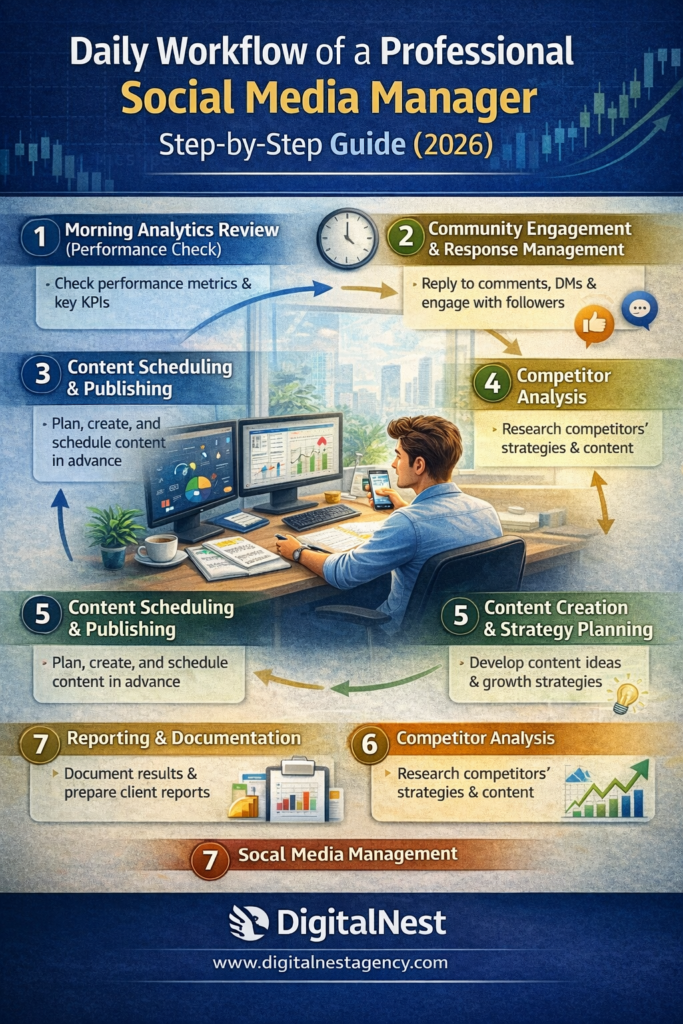
Step 1: Morning Analytics Review (Performance Check)
The first task every morning is reviewing analytics.
A professional social media manager checks:
Engagement rate
Reach & impressions
Follower growth
Click-through rate (CTR)
Conversion metrics
This helps in understanding:
What content performed well
What needs improvement
Which audience segment is most active
Data drives decisions — not guesses.
Step 2: Community Engagement & Response Management
Engagement is a major ranking factor on social platforms.
Daily tasks include:
✔ Replying to comments
✔ Responding to DMs
✔ Engaging with followers’ content
✔ Monitoring brand mentions
Fast responses increase trust and brand credibility.
Step 3: Content Scheduling & Publishing
Professional managers don’t create content randomly.
They use:
Monthly content calendars
Pre-approved creatives
Caption strategies
Hashtag research
Tools like scheduling platforms help maintain consistency.
Consistency builds algorithm trust.
Step 4: Competitor Analysis
To stay ahead, daily competitor research is essential.
We analyze:
Their content type
Engagement rate
Posting frequency
Trending formats
Paid ad creatives
This helps in identifying opportunities to outperform them.
Unlike freelancers, agencies follow systematic competitive benchmarking.
Step 5: Content Creation & Strategy Planning
Content creation is ongoing.
This includes:
Script writing for reels
Designing posts
Writing high-converting captions
Planning carousel content
Creating hooks for better retention
A professional social media manager focuses on value-driven and conversion-focused content.
Step 6: Paid Campaign Monitoring (If Running Ads)
If ad campaigns are active, daily monitoring is critical.
Key checks include:
Cost per click (CPC)
Cost per lead (CPL)
Ad relevance score
Conversion rate
Budget adjustments and A/B testing help improve ROI.
Step 7: Reporting & Documentation
Professional agencies maintain daily records.
Weekly or monthly reports include:
✔ Growth metrics
✔ Campaign performance
✔ Audience insights
✔ Recommendations
Clients prefer measurable results — not assumptions.
Tools Used by Professional Social Media Managers
A professional workflow includes tools for:
Content scheduling
Analytics tracking
Graphic design
Keyword research
Competitor monitoring
Using tools increases efficiency and accuracy.
How Agencies Differ from Freelancers
Freelancers often:
❌ Handle multiple niches without specialization
❌ Lack structured reporting
❌ Focus only on posting
Agencies like DigitalNest Agency focus on:
✔ Strategic planning
✔ Conversion-focused campaigns
✔ Data-driven decisions
✔ Brand positioning
✔ Long-term growth
Structured workflow = consistent results.
Skills Required to Be a Professional Social Media Manager
Content strategy
Copywriting
Analytics interpretation
Graphic understanding
Communication skills
Trend analysis
Social media management is both creative and analytical.
Final Thoughts
Managing social media professionally requires discipline, planning, and data-backed decisions.
It’s not about posting daily — it’s about posting with purpose.
At DigitalNest Agency, we implement structured workflows that help brands grow consistently and profitably.
If your business wants structured growth instead of random posting, professional management is essential.